
Why Trust This Article?
- • Author: Hesham Al-Daaja (based in China since 2019)
- • Last updated: Oct 7, 2026
- • Based on direct field experience with Arab travelers and buyers
Ramadan in China is different from any Arab country
I'm Hesham, living in China since 2019. The first thing that surprises any Arab planning to fast Ramadan in China is that the entire country -- from Beijing in the east to Kashgar in the far west -- runs on one single official time zone (Beijing Time, UTC+8), even though the landmass naturally spans close to five time zones. That means your "clock" fasting hours can actually differ quite a bit from your "sun" fasting hours depending on where you are in China, and that's something you need to understand before you plan.
The Quick Answer
Use a reliable prayer-times app (like Muslim Pro or a local equivalent) that calculates Fajr and Maghrib based on your actual GPS location, not just official Beijing time -- the gap can be an hour or more the further west you go. Eastern cities (Beijing, Shanghai, Guangzhou) are closer to natural solar time, so their calculation is simpler.
Why the unified time zone affects your fasting calculation
China is geographically massive, stretching east to west across roughly five natural time zones, but the government unified the whole country onto Beijing Time back in 1949. The result: in eastern cities (Beijing, Shanghai, Guangzhou) official time is close to natural solar time, but the further west you go (like Xinjiang), the gap grows -- the sun might not actually rise until 9am by official clock time. That means the true astronomical Fajr and Maghrib times can differ from what a generic calendar shows if it's based on Beijing time without geographic adjustment.
Where to easily find halal iftar food
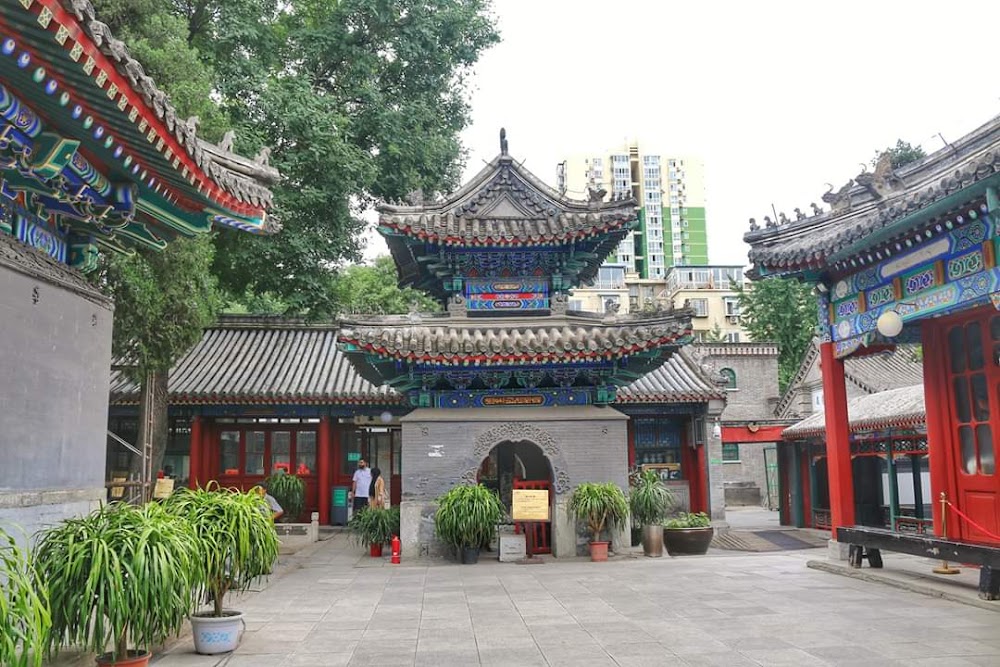
The easiest place to break your fast in China is in the historic neighborhoods of Chinese Muslims (Hui) or Uyghurs -- like Niujie in Beijing (around Niujie Mosque), the Muslim Quarter in Xi'an (回民街), or Xiaobei in Guangzhou (China's largest Arab community). These areas have a real density of halal restaurants, and some offer special iftar meals specifically during Ramadan. Outside these neighborhoods, halal food exists but is more scattered -- check the halal restaurant guide on this site before traveling to any city.
Mosques: real places for prayer and communal iftar
China has a long Islamic history, with real, functioning mosques in most major cities -- Niujie Mosque in Beijing (one of China's oldest), Huaisheng Mosque in Guangzhou (traditionally dated by local accounts to over 1,300 years ago), and the Great Mosque in Xi'an. Most of these mosques serve real communities of Chinese Muslims, and some organize communal iftars during Ramadan.
Quick Summary
- All of China runs on Beijing time -- use a GPS-based app to calculate your real fasting hours
- Hui and Uyghur neighborhoods (Niujie in Beijing, the Muslim Quarter in Xi'an, Xiaobei in Guangzhou) are the easiest places for iftar
- Real, functioning mosques exist in most major cities
Planning to travel or live in China during Ramadan?
I'm Hesham, living in China since 2019. I can help you plan your trip or stay in a way that accounts for fasting hours and real access to halal food. Message me on WhatsApp, or visit my custom trips page.


